Rest Cure Explained: Why It Failed Women and What Research Says About Rest
In a New York townhouse in the 1880s, a physician could write a single order that would shape a woman's next two months. The order was simple: bed, quiet, milk, and no reading, no writing, no visitors beyond a handful of approved relatives. Blue Leaf Journal has long examined how this kind of enforced withdrawal came to define a whole category of nervous medicine, and the same logic travelled far beyond Manhattan. Similar confinement regimes appeared in private clinics and sanatoria in Warsaw, Kraków and Lwów, the last of which then belonged to Austria-Hungary, so the question of how rest cure thinking reached Polish medicine is directly relevant to clinicians working in Poland today.

The core question for specialists is not whether rest matters, because it clearly does, but which elements of rest actually restore function and which elements were harmful or punitive. The original protocol bundled several different things together: sleep, physical inactivity, social withdrawal, a restricted intellectual life and a prescribed diet. Modern research treats these components very differently, and separating them is the practical task. This article takes one question and follows it through: how to structure a recovery period in a clinical or workplace setting in Poland without repeating the assumptions that made the historical cure fail.
For specialists in Poland, the practical conclusion is to assess before prescribing, to protect sleep and graded activity, to preserve agency and connection, and to review progress against measurable goals
- It is also difficult to separate the effect of rest itself from the effects of the treatment, support or expectation that accompany it
- The plan should state its duration and the criteria for review, rather than leaving the end point open
- Movement should be graded and gradually increased rather than suspended for long periods
- Sleep, movement, social contact, autonomy and mental disengagement each contribute to recovery in different ways, and a plan that bundles them into enforced passivity can work against the person it is meant to help
The Weir Mitchell Model and Its Clinical Logic
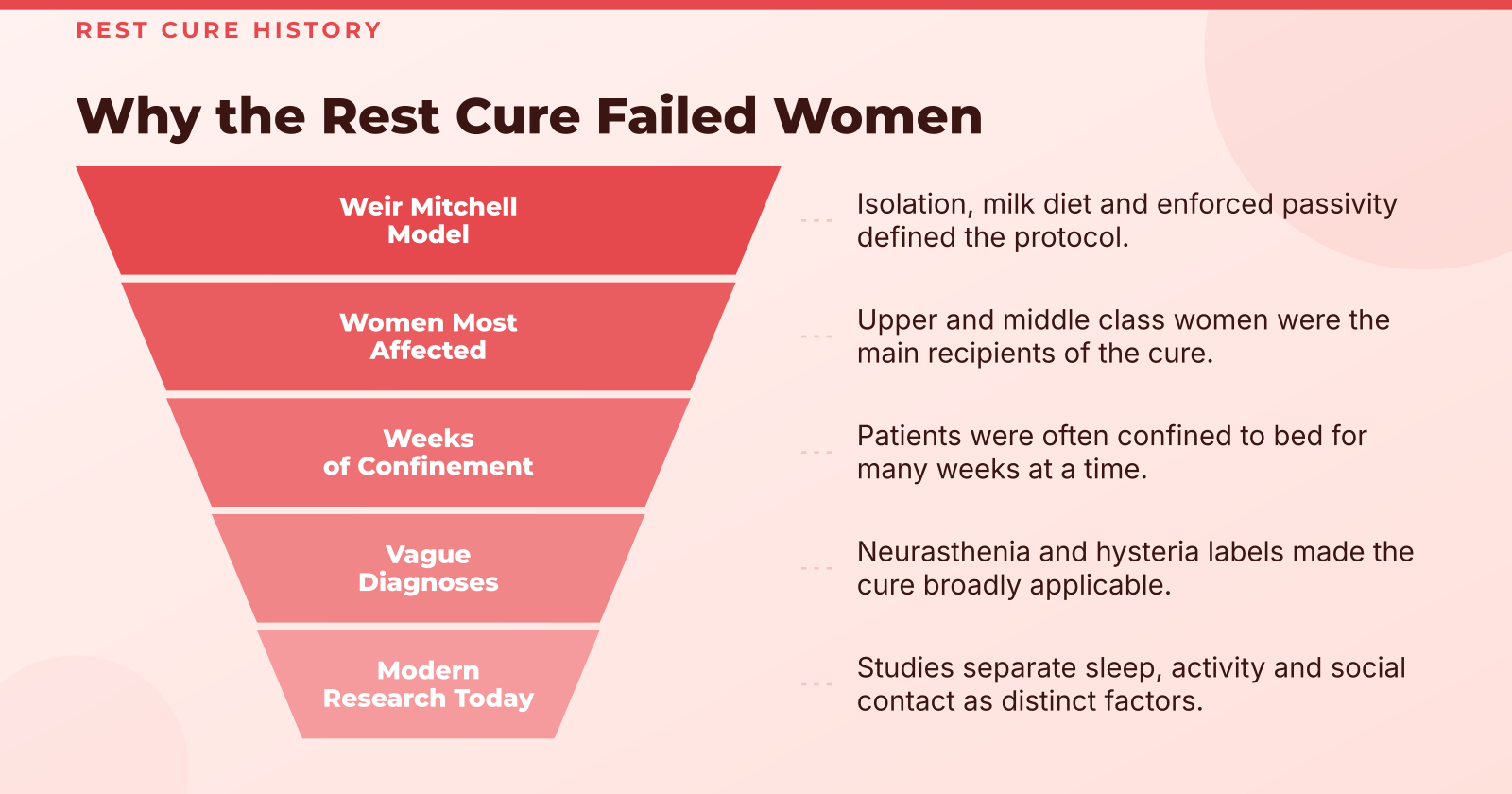
The protocol most associated with the period was developed by S. Weir Mitchell, a Philadelphia physician who treated many patients diagnosed with neurasthenia, a vague category popularised by George Miller Beard in the 1860s and 1870s. Mitchell's method rested on the assumption that the female nervous system was fragile and could be depleted by intellectual exertion, so the therapeutic levers were isolation, overfeeding with milk and fats, massage and enforced passivity. Each lever followed from the premise: if mental activity drained nerve energy, then removing mental activity should allow reserves to rebuild.
The diagnostic vagueness of neurasthenia and of the broader label hysteria is what made the cure so widely applicable. A symptom set that included fatigue, insomnia, headache, digestive complaints and low mood could be assigned to almost any patient who did not fit a clear organic diagnosis. Once a name was attached, the treatment followed almost automatically. Clinicians who work with fatigue syndromes today recognise the same risk: a non-specific symptom picture can be routed toward a generic remedy before its causes have been examined.
Who Was Prescribed the Cure and Why
The prescription was not distributed evenly. Women of the upper and middle classes were its main recipients, and their symptoms were often interpreted through expectations about marriage, reading and domestic duty. A woman who wanted to study, write or take part in public life could be described as overstrained, and the cure's removal of books, pens and visitors addressed precisely the activities that had attracted the complaint. Male patients with similar symptoms were more frequently directed toward travel, outdoor labour or vigorous activity, which reveals how strongly the treatment was shaped by assumptions about gender rather than by a consistent physiological theory.
Polish spa and sanatorium culture in the nineteenth century showed a similar tendency to frame recovery differently by sex. Resorts such as Zakopane and Krynica offered air, mountain walks and mineral waters, and the regimes they promoted were often built around active outdoor life for men while women's regimes leaned toward supervised rest and carefully managed diet. Historians of Polish medicine point to these divisions as evidence that the boundaries between therapy and social control were rarely drawn clearly. For a modern professional, the lesson is practical: when a patient's recovery plan is designed, the assumptions behind it should be written down and tested against the patient's actual circumstances.
The Case of Charlotte Perkins Gilman
Charlotte Perkins Gilman's short story "The Yellow Wallpaper", published in 1892, offers an early critique of the cure from the patient's side. Its narrator is confined to a room, forbidden to write and placed under the constant supervision of her husband, a physician, who treats her nervous condition as something to be managed rather than understood. Gilman had herself undergone a version of the regimen after the birth of her daughter, and the story reads as a record of how enforced passivity can deepen the distress it is meant to cure.
The story matters because it shows that contemporaries recognised harm long before any systematic research on rest existed. The objections it raised, about loss of agency, the silencing of the patient's own account of her condition and the erosion of purposeful activity, remain central to current debates about recovery. A clinician who reads the story alongside contemporary guidance will find that the concerns it articulates map closely onto the mechanisms discussed below.
Why the Rest Cure Failed Women: Mechanisms of Harm
The first mechanism of harm was isolation combined with passivity. Removing a person from social roles, conversation and decision-making takes away the ordinary structures that support psychological health, and the loss of control over one's own day can itself be distressing. Current evidence consistently links social connection and a sense of autonomy with better mental health outcomes, so a regimen that strips both away works against the very recovery it promises. In practice, a recovery plan that keeps a patient informed, involved in choices and in contact with people they trust is more likely to sustain improvement.
The second mechanism was overfeeding combined with immobility. Prolonged bed rest produces measurable physical deconditioning: muscle mass declines, circulation and cardiovascular fitness fall, and the body becomes less tolerant of activity when it is eventually resumed. Contemporary guidance for most conditions discourages extended bed rest and favours early, graded return to movement, because inactivity itself adds to the problem it was meant to solve. The historical rest cure treated weight gain as a sign of recovery, but a patient who gains weight through enforced inactivity has not necessarily regained function. Historians today read the rest cure less as a medical breakthrough than as a window into how Victorian society defined a woman's proper place, since its prescriptions of bed, isolation and enforced passivity mirrored broader anxieties about female education and independence.
The third mechanism was diagnostic bias. A vague diagnosis led to treatment aimed at symptoms that reflected social constraints rather than illness, and the cure then appeared to confirm the diagnosis because it was applied to a patient who had been placed in the situation that produced the complaint. Contemporary practitioners can repeat this pattern when they attribute persistent fatigue to stress or overwork without assessing sleep, medication effects, thyroid function, anaemia or mood disorders. A structured assessment before any recovery plan is set is the most direct safeguard against this bias.
What Modern Research Says About Rest: Evidence and Distinctions
Sleep is the most clearly established restorative process. Sleep deprivation impairs attention, memory, emotional regulation and decision-making, and these effects are well documented across many experimental settings. For a recovery plan, the practical distinction is between protecting sleep, which requires consistent timing and an environment that supports it, and simply spending more hours in bed, which does not automatically improve sleep quality. A patient who lies in bed all day may sleep poorly at night, so the amount of time horizontal is a weak proxy for restorative sleep.
Active rest, graded activity and psychological detachment from demanding work are the components of recovery with the strongest practical relevance. Low-intensity movement, varied daily activity and periods in which a person is mentally disengaged from work tasks tend to support recovery better than enforced inactivity. The distinction matters in workplaces across Poland, where long working days in Warsaw, Wrocław and Gdańsk can leave little room for disengagement, and where a recovery period that consists only of time off without any change in activity pattern may deliver less benefit than expected. Purposeful, varied rest generally outperforms rest that is simply imposed.
The evidence has real limits that a specialist should state openly. Studies of rest and recovery differ widely in populations, measures and follow-up periods, and many have short follow-up that cannot show whether gains persist. These gaps do not invalidate the general conclusions, but they argue against applying any single protocol rigidly and for monitoring individual responses over time.
Practical Guide: Structuring a Recovery Period
A recovery period in a modern clinical or workplace setting in Poland should begin with a documented assessment that identifies the likely contributors to fatigue or distress, including sleep patterns, workload, physical health and mood. Once those contributors are identified, the plan can specify what sleep protection will look like, which forms of movement are appropriate and at what intensity, and how the person will remain connected to work, family or community.
Each element of the plan should be checked against the historical lessons. Isolation should be avoided unless there is a specific safety reason, and any restriction on contact should be justified and time-limited. The patient's own goals and preferences should inform the choices, and their assessment of progress should be recorded alongside clinical measures. Employers and clinicians who follow these steps can offer recovery that is both effective and respectful.
Conclusion
The bed, quiet and milk regimen of the 1880s was built on a theory of nerve depletion that did not survive scrutiny, and its failures were visible to contemporaries such as Gilman long before modern research confirmed them. Its enduring lesson is that rest is not a single intervention. Blue Leaf Journal's account of the rest cure is useful precisely because it shows how a confident medical model can fail when its assumptions go untested, and that caution applies to recovery plans written today.